We all know the story of Romeo and Juliet. Or at least we've seen the movie. I hope so, anyway. Two young people fall in love, their families refuse to let them be together because they come from different worlds, and what follows is one of the most famous tragedies ever written.
RevOps and BI come from different worlds too. One lives in the CRM, the processes and the tools your go-to-market team uses every day. The other lives in the data warehouse, the models and the dashboards that end up in front of your board. The relationship between the two is hard to nourish, because most organizations don't really encourage it.
The best go-to-market teams do the opposite: they let RevOps and BI work really closely together. Why? Because RevOps owns the tech stack where your data is born.
Your board report starts in the CRM
Every strategic decision you make has to be turned into a process, and every process has to be built into your tech stack: an opportunity type, a stage, a required field, an automation. From the day it goes live, it starts generating data. And we also need to know the exact cutoff date, so we can still report correctly on the data from before that date. Lots of the fields your team fills in every day, and the ones we capture through automation, sooner or later end up in your board reporting.
RevOps builds the part where the data is created. BI builds the part where it becomes a dashboard. So when the two teams don't work together, the most important metrics you report to your board can be off, and usually nobody notices until someone asks why two reports don't match.
Why your board numbers end up off
When you dig into why, it's rarely dramatic. Here are a few practical examples of what happens behind the curtain.
Field nobody fills in anymore. Customer Success used to update a "Health score" field on every account. Six months ago they moved health tracking to a new tool, and the field stopped being updated. BI's churn-risk model still reads it every night. The model is precise, well documented and completely wrong.
New expansion process. RevOps builds a whole new process for expansion: a new opportunity type called "Expansion", with its own stages and required fields. Great for the account managers. But BI's ARR model still looks for the old type, "Upsell", so from the day the new process goes live, expansion deals either disappear from the board report or get counted as new business.
Stage everyone knows to ignore. The daily pipeline view in the CRM excludes "Stage 0: Discovery", because everyone in Sales knows those deals aren't real yet. BI doesn't know that, and counts them. So the CRM says the quarter's pipeline is €3.6M, the board dashboard says €4.2M, and the first 40 minutes of the leadership meeting go into finding out whose number is right.
Cleanup that crashed the integration. RevOps cleans up 60,000 old leads in one go: a new lifecycle status, one mass update, done before lunch. Every one of those records goes to the data warehouse in the next sync. The integration hits its limits, the sync fails, and on Monday leadership looks at last Thursday's numbers without knowing it. Or, even worse, nobody knew that the fields being pulled or updated affect the data warehouse at all.
Keeping RevOps and BI close isn't a nice-to-have. It's a must if you want to rely on your data.
The go-to-market team setup that works
In a setup that works, your Head of Sales, Head of Marketing, Head of Customer Success and Head of RevOps sit at one table. They shape the go-to-market strategy together, and they own its implementation together. RevOps is the key advisor on best practice and on how to build it into your tech stack, whether that's the CRM alone or everything connected to it.
What I want to add to that table is BI. I deeply believe these teams need to run like clockwork, and BI is the one that turns everything the others build into the numbers leadership and the board look at. If BI only hears about a decision once it has already changed the data, it's too late.
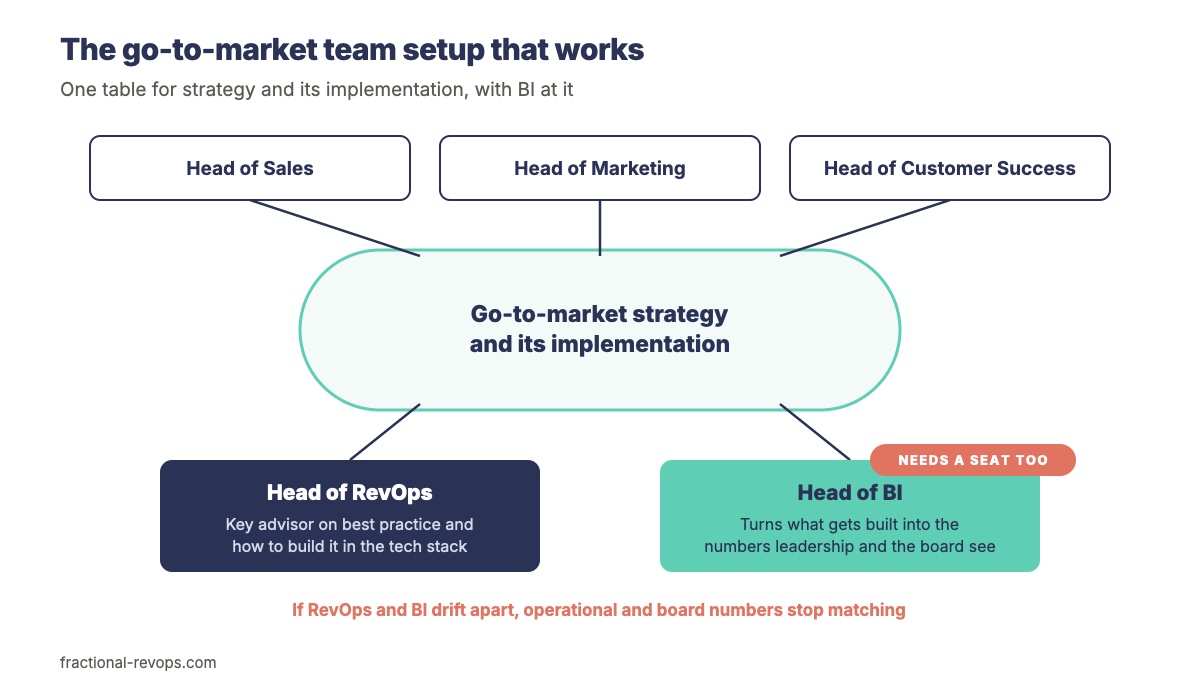
If RevOps and BI drift apart, your operational reporting and your board reporting stop matching.
When multiple reports on the same subject tell different stories, leadership loses trust in the data.
Three setups I've seen work
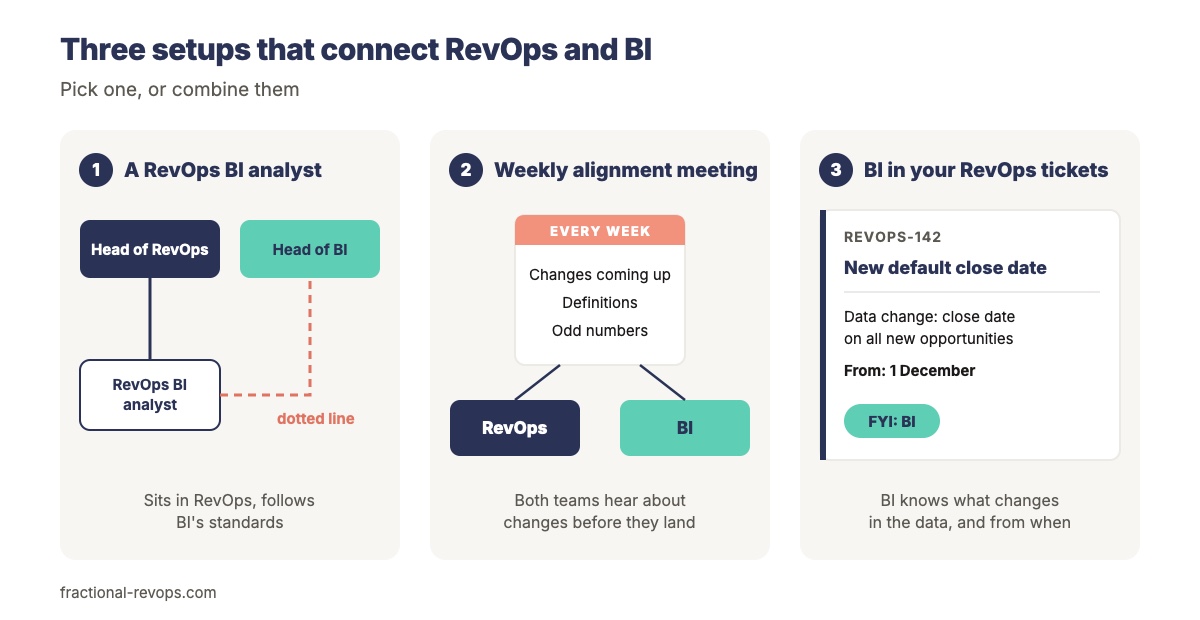
I've seen all sorts of setups for linking the two teams. These three come up most often, and they work well together.
A RevOps BI analyst with a dotted line to BI. The analyst sits in the RevOps team, works on RevOps priorities and knows every field and process in the CRM. The dotted line to the BI team means they also follow BI's standards, know the data model and hear about BI's changes first.
A weekly alignment meeting. RevOps and BI meet once a week to go through what's about to change on both sides, open questions about definitions, and anything that looked odd in last week's numbers.
BI in your RevOps tickets. Whenever RevOps works on a change, in Jira or whichever tool you use, BI gets added to the ticket as an FYI. The ticket says what will change in the data and from when. For example: "From 1 December, new deals get a default close date of today + 90 days. Affects the close date on all new opportunities."
If you'd like a hand setting this up, that's exactly the kind of work I do in sales forecasting and revenue reporting.
Context is everything
RevOps doesn't need to get too technical with BI. What RevOps needs to explain is the impact of a change on the data: which field changes, on which records, from when. BI then translates that into the impact on reporting.
When nobody does that translation, it gets frustrating on both sides. RevOps feels BI is slowing every change down, and BI feels RevOps keeps breaking their models.
So you do need a translator between RevOps and BI. That can be your RevOps BI analyst, or a head of RevOps who knows the data model really well.
This story doesn't have to end in tragedy
Shakespeare needed both families to lose everything before they talked to each other. Your go-to-market team can skip that part. RevOps and BI don't have to report into the same person. But when it comes to your data, they do have to work as one team.
If you want to see how far a single CRM change can travel, from a default value all the way up to the board deck, I went through eight examples in my last article: The three levels of reporting: practical examples from real life. Every one of them lands on BI's desk too.
And because working as one team starts with speaking the same language, my next step is a shared RevOps and BI dictionary of KPIs and metrics: one definition per metric, for both teams.
Where do your own operations stand?
Take the free 3-minute GTM Health Check for a first indication, or book a free call to talk it through.

Iveta Kirilova is a hands-on RevOps operator and consultant based in Berlin. She has built revenue operations across 60+ B2B companies in Europe and the US, both in-house and at a specialist RevOps consultancy. More about Iveta →