I once removed 50% of a company's pipeline (technically, we closed those deals as lost). On the dashboard, that was a drop that made everyone in leadership sit up a little straighter. But the company still met its target that quarter, and the next one.
Why, you might ask? Because we tightened the criteria for what counts as a deal, and for how long a deal without any activity is allowed to stay in the pipeline. That let the reps focus on the deals they could actually close. In sales, "not now" most of the time simply means "no", and there's zero reason to keep deals parked in dead stages like "pending", "follow back" or similar.
That experience taught me one of the most important skills you develop as you grow in Revenue Operations, and it has surprisingly little to do with technology. It's the ability to understand how the processes you build and change affect the numbers your leadership team uses to run the business. That goes beyond how data is generated in the CRM and turned into dashboards: it means understanding how the CEO, CRO, CFO and other decision-makers actually read it.
Because better operations don't always show up as better numbers, at least not straight away. And if you can't explain why, you might find yourself defending a perfectly reasonable operational decision in your next leadership meeting, while everyone around the table is busy shooting the messenger.
The numbers don't exist in isolation
As operators, we spend a lot of time with systems, processes and data. We define lifecycle stages, build workflows, set qualification criteria, introduce forecasting methodologies and improve reporting, and naturally, we focus on whether all of that works as intended. But there's another dimension to the job.
Every significant operational change has the potential to change the numbers leadership sees.
Sometimes those changes reflect a genuine improvement or deterioration in business performance, sometimes they reflect a change in how we measure the business, and often it's a bit of both. Telling them apart is essential, because leadership uses your dashboards to make real decisions about hiring, investments, resource allocation, commercial strategy and revenue expectations. When those numbers move unexpectedly, the consequences can be significant.
Let's take a relatively simple example: deal qualification
Imagine a growing B2B company. The sales team generates a healthy volume of opportunities, but conversion rates are disappointing. Sales cycles are long, forecasting is difficult, and sales reps spend a lot of their time chasing deals that rarely close.
So you start investigating. You review the ideal customer profile and buyer personas, analyze historical opportunities and talk to the reps about the deals they're working on. Patterns start to emerge:
- Certain customer segments consistently convert poorly.
- Some prospects lack the buying power your offering requires.
- Others have needs that don't fit your product particularly well.
- And some industries have purchasing processes so long that pursuing them doesn't make commercial sense at the company's current stage.
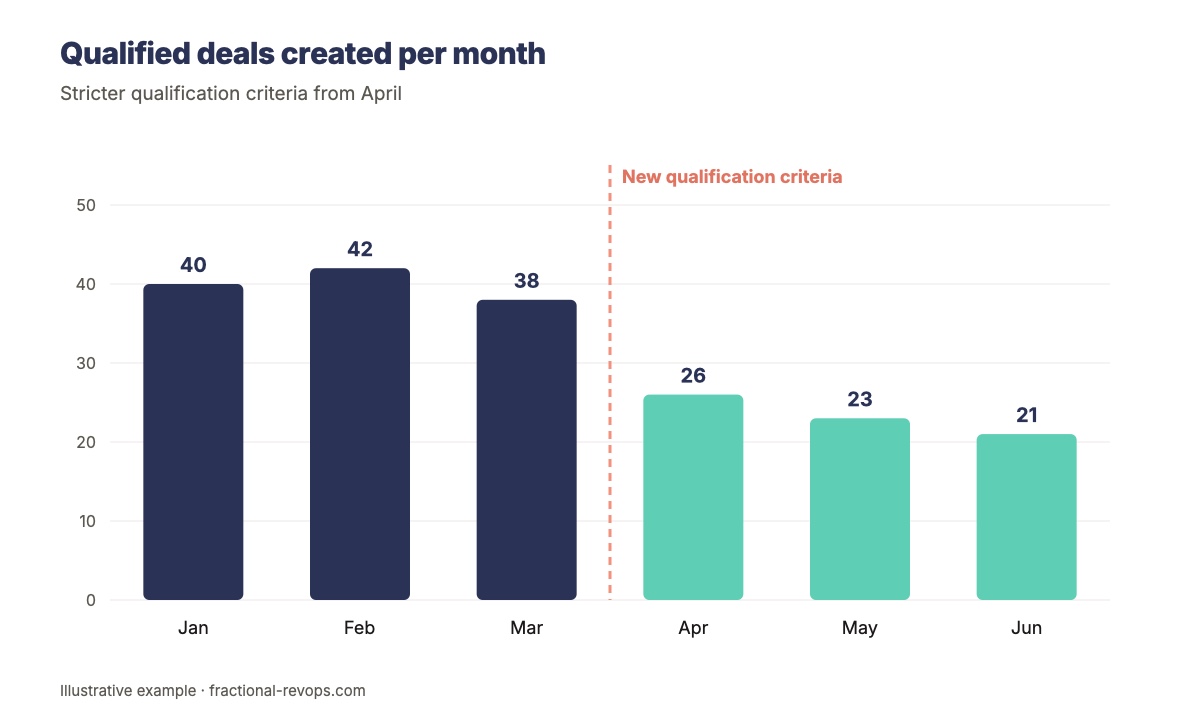
Together with Sales leadership, you introduce clearer qualification criteria. The goal is simple: help sales reps spend their time on opportunities with a realistic chance of becoming customers. Over the following months, the new methodology starts to shape which deals make it into the qualified pipeline. And then something interesting happens: newly created qualified pipeline starts to decline.
The operational improvement that looks like a commercial problem
Say the opportunities created in the first quarter still followed the old, fairly loose qualification approach, and from the second quarter onward the company applies the stricter criteria. Leadership opens the dashboard and sees that the value of newly created qualified pipeline has dropped, which is rarely a welcome sight. The CRO starts questioning pipeline generation, the CEO wonders whether demand is weakening, and Finance gets nervous about future revenue. Suddenly, a process improvement meant to make the sales organization more efficient looks like a commercial performance problem.
But here's the important distinction.
The business has changed which opportunities count as genuine sales pipeline, and that is something different from generating less demand.
Before, the company was counting opportunities with a fairly low chance of converting. Now it applies more discipline before accepting them into the qualified pipeline. The number has changed, but so has what the number represents, and that needs to be understood before anyone draws conclusions about business performance. In a simplified example, it can look like this:
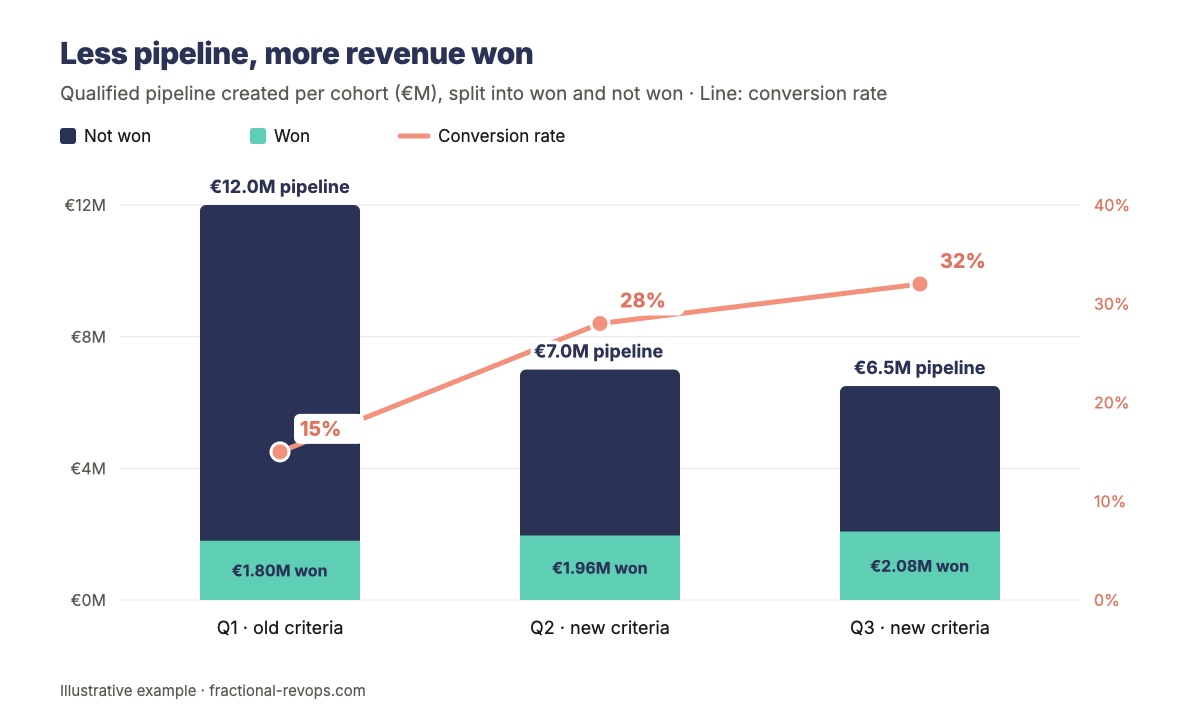
Roughly half the pipeline, and more revenue won. That's the whole story the pipeline chart on its own doesn't tell.
This is where RevOps needs to translate the numbers
A RevOps professional implementing the new methodology should understand why qualified pipeline creation has declined. A senior RevOps leader needs to go further: anticipate that decline before the methodology is introduced, know which executive-level metrics will be affected, and explain what leadership should expect to see, why it's happening and how the business will judge whether the change worked.
In our qualification example, that means looking beyond the immediate pipeline numbers:
- What happens to the conversion rates of opportunities created under the new methodology?
- Are sales reps spending less time on poor-fit prospects?
- Are sales cycles getting shorter?
- Are we generating comparable or higher revenue from a smaller qualified pipeline?
- And importantly, is the total volume of potential demand actually changing?
Not all of these questions can be answered straight away. You need to give the new cohorts time to mature. Comparing opportunities created under the old approach with those created under the new one shows whether conversion efficiency improves over time, as long as you remember they were qualified by different rules (I wrote about why records built on changing definitions aren't directly comparable in part 2 of my first series).
You also need to look at the full funnel. A higher win rate among qualified opportunities doesn't automatically mean the business is generating more revenue. If far fewer opportunities qualify, or average deal values drop, the commercial outcome might still be worse. The goal is to understand whether the new process genuinely improves business performance, and to communicate that clearly.
Don't wait for leadership to notice
This, I think, is where the real difference between operational execution and operational leadership becomes visible. You shouldn't wait until the CRO asks why pipeline creation has declined. Before you implement a significant process change, you should already know which KPIs are likely to move, in which direction and for how long, and what context leadership will need to read them correctly.
In the qualification example, the conversation can be as simple as this:
"We're introducing stricter qualification criteria to improve sales efficiency. As a result, we expect newly created qualified pipeline to decline compared with historical levels. That doesn't necessarily mean demand is decreasing. We'll monitor the earlier stages of the funnel and evaluate the conversion performance of the new cohorts as they mature."
That's a very different conversation from explaining a declining pipeline after the fact. It helps leadership tell expected changes in reporting apart from genuine commercial risks, and it sets the right expectations about when results can reasonably be evaluated.
This applies to far more than qualification
The same principle shows up all over Revenue Operations. None of these changes is good or bad in itself, but each one can shape how leadership reads commercial performance:
| If you… | The numbers might show… | While in reality… |
|---|---|---|
| Change your opportunity stage definitions | Stage conversion rates that suddenly look better or worse | Old and new conversion rates are no longer directly comparable |
| Introduce stricter lead qualification | Marketing generating fewer qualified leads | The quality of those leads may well have improved |
| Redesign your customer lifecycle processes | Churn or retention moving unexpectedly | You're identifying and categorizing customer outcomes differently |
| Introduce a new attribution model | Channel performance shifting dramatically | Actual customer acquisition hasn't changed |
| Clean up outdated opportunities | Lower total open pipeline and pipeline coverage | The business hasn't lost any newly created demand |
That's why understanding the operational origins of business metrics matters so much.
Knowing your data means knowing how the business reads it
I often hear that a good RevOps professional needs to know their data, and I agree. But I think we need to broaden what that means. Knowing your data goes beyond understanding which CRM fields feed which reports, or knowing how to write a query, build a dashboard or troubleshoot a broken integration. It means understanding how information moves from everyday business activities into the metrics used for executive decisions, and what happens to those metrics when the underlying processes change.
A declining pipeline number might point to a genuine commercial problem, or it might reflect a more disciplined qualification process. A sudden jump in conversion rates might mean better sales execution, or simply a change in which opportunities are included in the calculation. The number alone doesn't tell you which.
Your responsibility is to understand the difference and make sure the people making decisions understand it too.
Making space for RevOps in leadership conversations
I believe this is one of the areas where senior Revenue Operations professionals can create tremendous value: by being part of the conversations where operational decisions and commercial strategy meet, without attending every executive meeting or adding another layer of reporting. When leadership discusses revenue predictability, sales productivity, pipeline generation or commercial efficiency, RevOps should bring more than a dashboard. It should bring an understanding of how the business actually operates: which processes influence the numbers, where the data is reliable, where assumptions need challenging, and how proposed changes might affect both execution and measurement.
That takes business acumen, analytical thinking and the confidence to challenge interpretations that don't match operational reality. Sometimes it also means telling leadership something they don't necessarily want to hear: that a seemingly positive KPI movement isn't actually evidence of improvement, that a worrying decline doesn't necessarily mean performance is deteriorating, or that a process improvement hasn't delivered the expected commercial outcome. All three conversations matter.
The real value lies in what the numbers mean
As Revenue Operations professionals, we're often responsible for improving processes, systems, reporting and data quality. But our work doesn't end when the implementation is complete. We also need to understand how those improvements influence business performance, and how that performance is interpreted. An operational change can improve the business while temporarily making a metric look worse, and it can make a metric look better without improving the business at all.
The job is to make sure leadership understands what the numbers actually mean. And perhaps that's one of the clearest distinctions between managing Revenue Operations and leading it.
Where do your own operations stand?
Take the free 3-minute GTM Health Check for a first indication, or book a free call to talk it through.

Iveta Kirilova is a hands-on RevOps operator and consultant based in Berlin. She has built revenue operations across 60+ B2B companies in Europe and the US, both in-house and at a specialist RevOps consultancy. More about Iveta →